On 12 November 2026 NVIDIA's board announced that Jensen Huang had resigned as president, chief executive officer and a director, effective immediately. He co-founded the company in 1993, so the run lasted 33 years. The shares fell as much as 14% in the session and closed 4.3% lower at $166.19, the biggest single-day drop since January 2025. That took the market value below Microsoft's. As of 12 November 2026, an interim chief executive is running the company with no permanent successor named.
The board named Colette Kress, 59, as interim CEO. She has been executive vice president and chief financial officer since 2013, and she keeps both titles while the search runs. The company says it will consider internal and external candidates. It also appointed Harvey C. Jones, 73, as its first-ever chair. Jones has been a director since 1993 and is a former Synopsys CEO, and the move separates the roles Huang had held together. The Form 8-K filed on 12 November records the board's acceptance of the resignation on 11 November, and Kress signed it under three titles. Third-quarter fiscal 2027 results are due on 17 November.
Huang's resignation followed an 8 November letter to employees, in which he acknowledged a personal relationship and apologised. A board-initiated independent review is also under way, amid national-security questions reported by US media. The details of that review aren't public. The event itself is settled. What matters for the market runs downstream, through the CUDA ecosystem, the hyperscalers' custom chips, and the supply chain.
CUDA lock-in
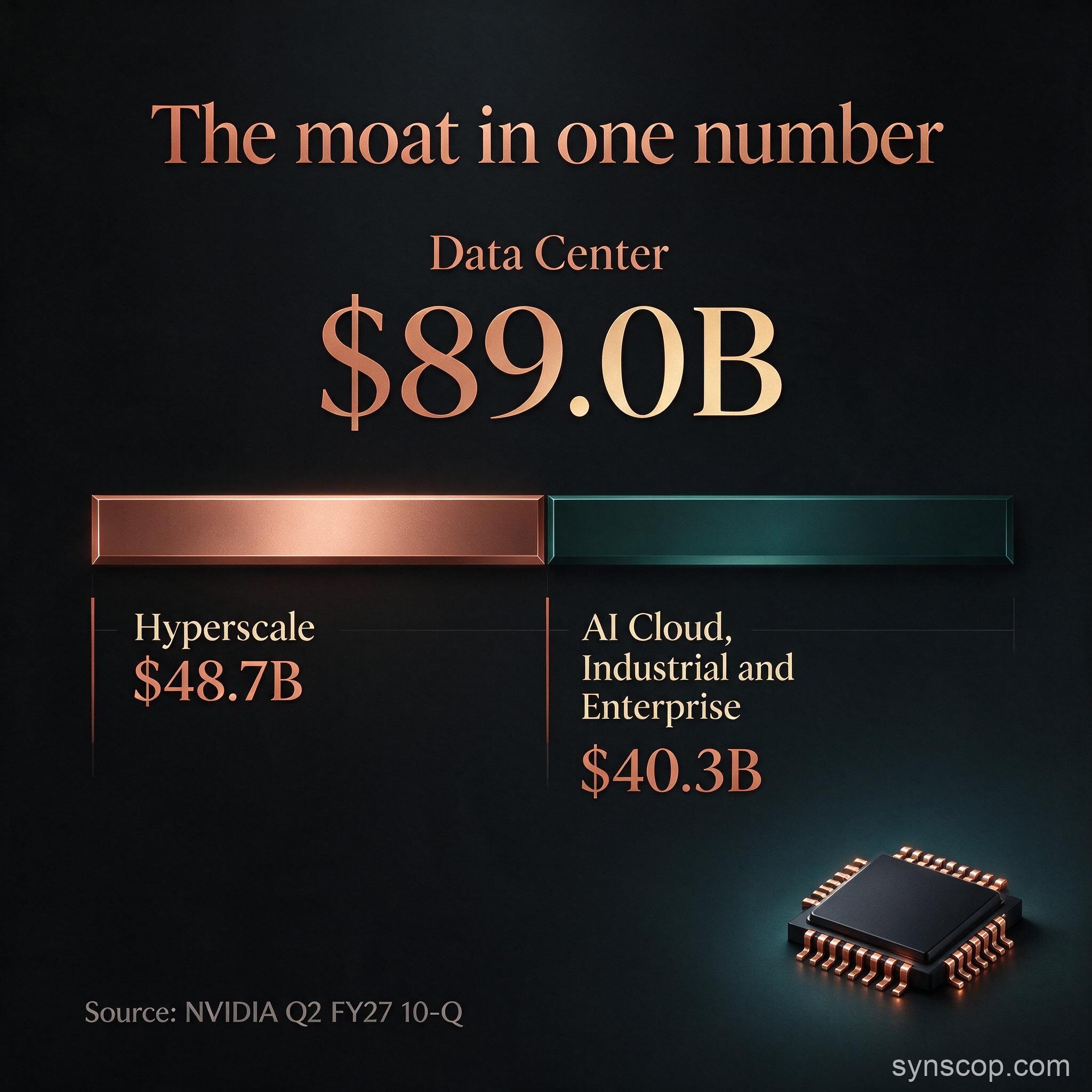
The moat shows up in revenue concentration. In the quarter ended 26 July 2026, NVIDIA reported Data Center revenue of $89.0B, which was 92% of total revenue and up 117% year over year. The hyperscale slice alone was $48.7B, up 102%.
Blackwell still accounted for the majority of system shipments. Vera Rubin was ramping into full production, with racks running at CoreWeave, Google Cloud, Microsoft Azure, Oracle Cloud Infrastructure and Nebius.
Software lock-in doesn't move when a chief executive leaves. It sits in the installed base that the 92% figure describes. CUDA is a two-decade head start in one compilation target and one library surface, and every serious AI framework targets it first. The advantage compounds in the same quarter's split. The AI Cloud, Industrial and Enterprise slice reached $40.3B, up 138%, so the position reaches past the hyperscalers into enterprises, AI-native companies and sovereign customers. Those buyers, alongside the clouds, are the base that would have to recompile for a rival stack to matter.
What a resignation does change is the posture on top of CUDA: pricing, how tightly hardware and software are bundled, and how fast the company answers each hyperscaler's in-house silicon. A permanent successor inherits those decisions. The interim doesn't reset them.
One weakness shows up if the interim period runs long. Business Insider reported that Kress, unlike Huang, lacks the engineering background behind the product vision. It also reported that Ian Buck, who helped create CUDA, is the internal name analysts mention most. A CFO-led company keeps the financial engine intact and is unlikely to change CUDA's course. The risk is drift in product direction while the board shops.
The hyperscaler ASIC window
The threat isn't new, and it didn't start this week. Every large cloud is building its own accelerator, and most of that work is co-designed with two outside firms. Broadcom designs Google's TPU and OpenAI's custom chip. Marvell designs AWS Trainium and Microsoft Maia. Broadcom carries a $73B AI backlog and targets $100B in AI chip revenue by 2027, while Marvell projects roughly $11B in AI ASIC revenue for 2026. At the design layer, the clouds' "in-house silicon" is largely a Broadcom and Marvell business. The design partner collects the service fees and the networking IP. The cloud keeps the chip and the roadmap.
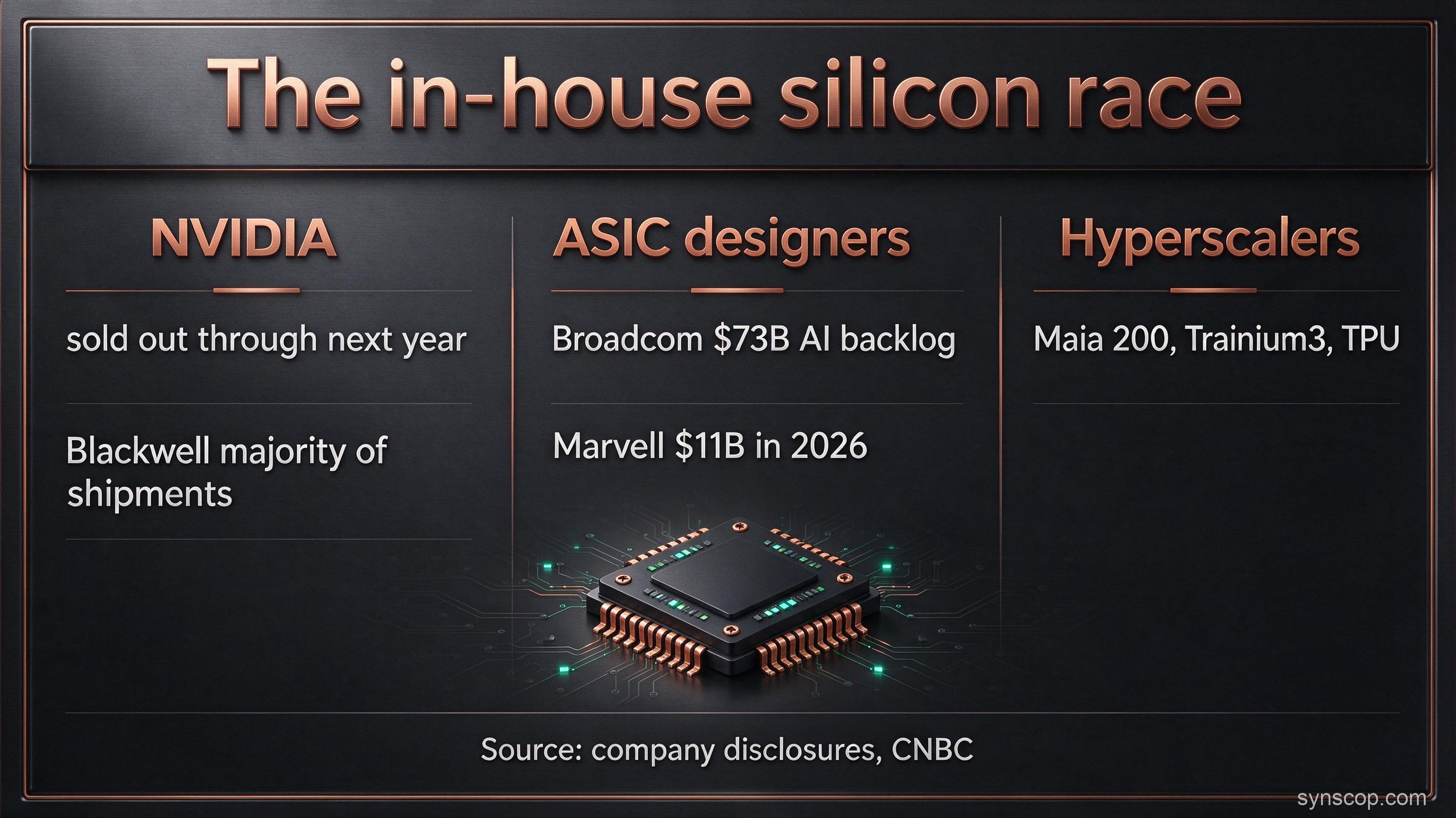
A leadership vacuum is the one thing that could hand those programs an opening, because the pitch of an ASIC is execution certainty. A cloud that owns its chip owns its roadmap and its cost curve. The programs are real and shipping. Microsoft's Maia 200, built on TSMC 3nm with more than 140 billion transistors, entered deployment in January 2026, and Microsoft claims 30% better performance per dollar than its existing fleet. AWS's Trainium3, its first 3nm part, went generally available in December 2025.
The counterargument is that NVIDIA's roadmap is already sold. An analyst told CNBC that NVIDIA is sold out through the end of next year, and the 10-Q shows Blackwell as the majority of shipments with Rubin entering full production. Multi-year commitments of that kind don't get renegotiated the day a CEO resigns. The ASIC shift is secular and will proceed regardless. What the transition could affect is pace, and pace depends on whether the interim period stretches into months.
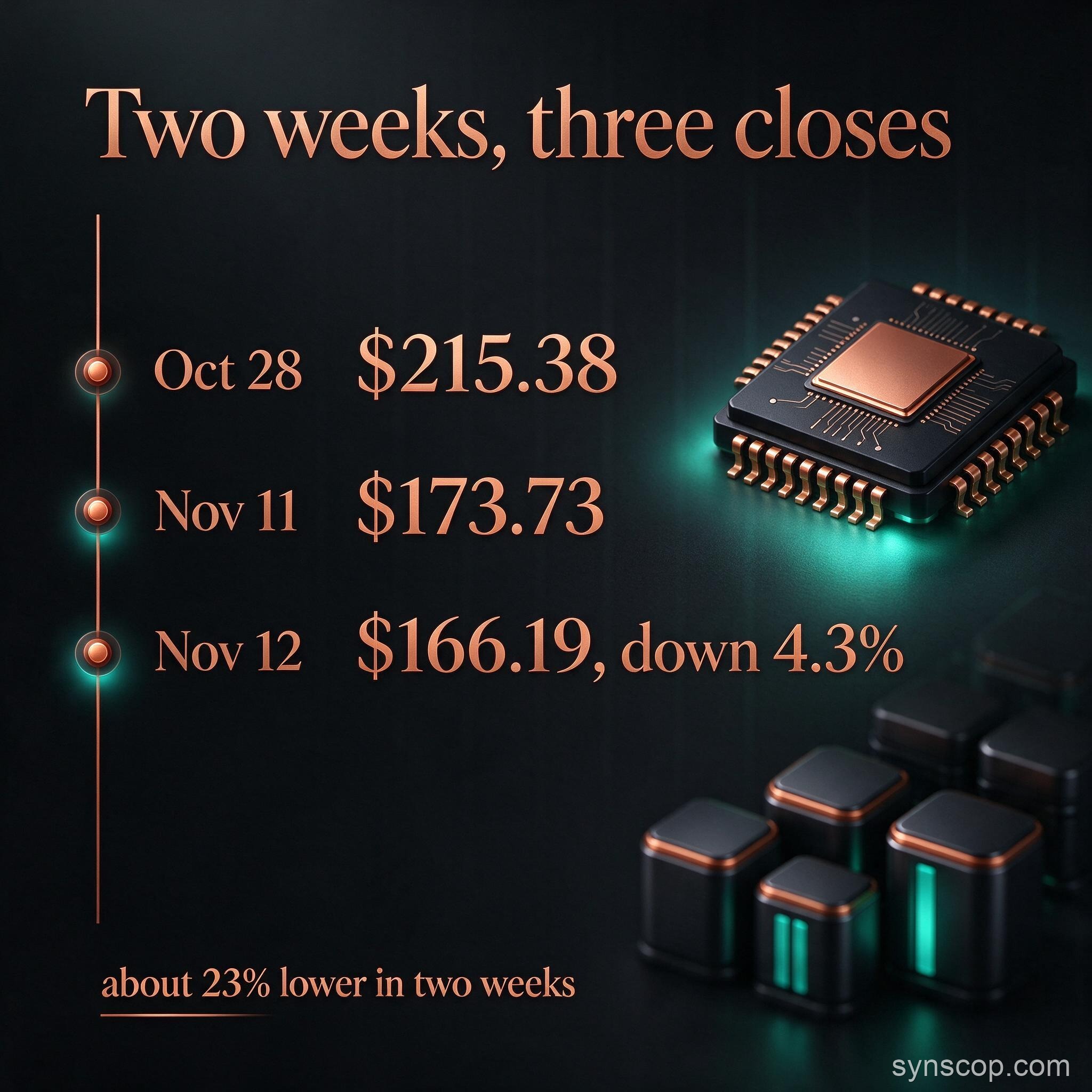
The market's verdict was visible on 12 November. Shares opened down more than 13% and recovered to a 4.3% decline. That reads as keyman risk and some timeline uncertainty, not a rerating of the fundamental position. The slide predates the resignation. The shares closed at $215.38 on 28 October, $173.73 on 11 November, and $166.19 on 12 November, down about 23% over two weeks as the disclosures and the board's review surfaced.
A named successor is missing.
Huang has said he doesn't believe in succession planning, and that gap is what analysts are pricing.
Supply chain and the backlog
Supply is where an interim CFO looks most like a continuation. Kress has run the finance function through the entire data-center ramp, the period when TSMC packaging capacity and HBM allocation became the constraint on revenue. The Q3 fiscal 2027 guide is revenue of $108.0B plus or minus 2%, with gross margin of 74.0% plus or minus 50 basis points. It assumes no Data Center compute revenue from China, a constraint set by export controls.
For several quarters, allocation has capped revenue. The finance and operations teams that execute it are still in place. A transition at the top doesn't change the TSMC wafer commitments, the CoWoS capacity, or the fact that the company can't ship what it can't package. Those commitments run on multi-quarter lead times, so a change in leadership doesn't move the queue. The most exposed group is the AI Cloud, Industrial and Enterprise customers at $40.3B and up 138%. The risk there is a mis-step in roadmap cadence that the sold-out position currently hides.
Succession precedents and the dates ahead
Founder departures have two reference points, and they point in opposite directions. When Steve Jobs handed Apple to Tim Cook in 2011, Apple was worth roughly $350B, and it passed $3T within a decade, because an operations executive inherited an intact product and supply engine. When Bill Gates handed Microsoft to Steve Ballmer in 2000, the company sat near a $600B market value and then spent roughly fifteen years below that peak, because it bet on a direction the market didn't reward. Kress looks closer to the Cook profile: a finance and operations executive inheriting a business whose roadmap is already locked. Business Insider noted that she is the company's only other highly visible executive, which is why the board reached for her on day one.
The differences matter. Apple in 2011 had a named successor inside the company who had already been acting CEO twice. NVIDIA has an interim and a search that includes outside candidates, so the set of outcomes is wider. The first observable test is 17 November, when the Q3 print and the call will show whether the guide holds and how much detail Kress gives on the search. The second is the shareholder litigation and the board's independent review, both reported and ongoing. Those will keep the governance question alive regardless of the financials.
Raymond James analyst Simon Leopold kept the stock at Strong Buy and wrote that he doubted "the distraction created by the CEO's indiscretions alters the fundamentals." That is the counter-evidence in its strongest form: demand, backlog and the CUDA position are all in place, and what changed on 12 November is who stands next to them. Oppenheimer went the other way and withdrew its price target entirely. The range of outcomes has widened, even if the midpoint hasn't moved.
References
- NVIDIA Announces CEO Transition (NVIDIA Newsroom)
- NVIDIA Announces CEO Transition (Investor Relations)
- NVIDIA Form 10-Q, quarter ended July 26, 2026 (SEC)
- NVIDIA Announces Financial Results for Second Quarter Fiscal 2027 (NVIDIA Newsroom)
- Stock Market News, Nov. 12, 2026 (WSJ live coverage)
- Nvidia live updates: Jensen Huang resigns (Yahoo Finance)
- NVIDIA Appoints Colette Kress as interim CEO (Business Insider, via Yahoo)
Loading comments…