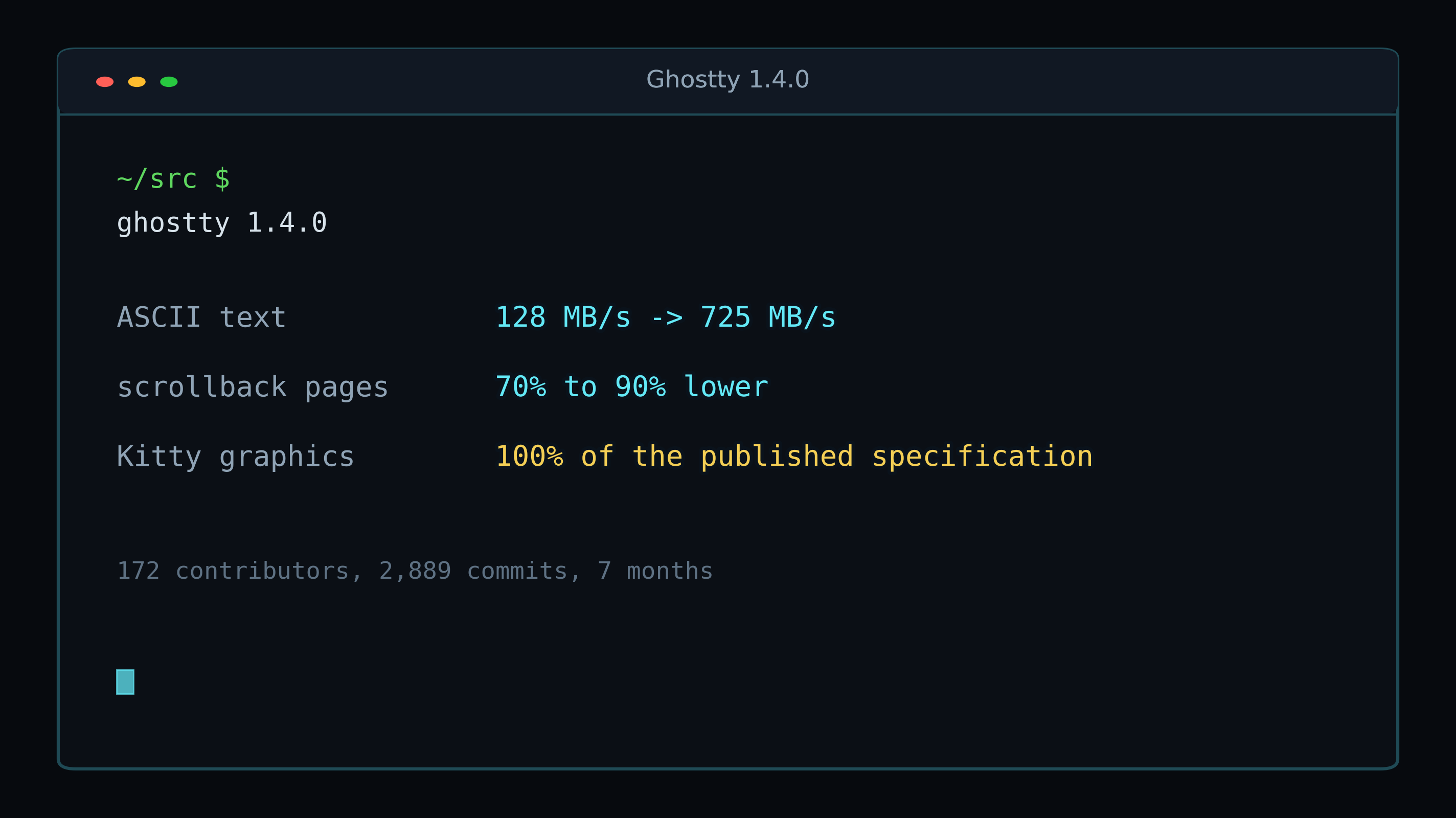
Ghostty 1.4.0 shipped on 27 October 2026, seven months after 1.3.0, with changes from 172 contributors across 2,889 commits. The release notes are hand-written by the maintainers, include the full changelog, and the project says they take a combined 16+ hours to produce. Three claims carry the release: lower memory, higher throughput, and a Kitty graphics implementation that now covers 100% of the published specification, which the project says makes Ghostty and libghostty the first terminals outside Kitty itself to get there.
The numbers behind those claims are specific enough to check, and most of them come with the hardware they were measured on. That matters for a terminal, where the interesting work is usually a few hundred microseconds of overhead repeated a few million times.
The release
Ghostty is a terminal written in Zig with a native macOS app and a GTK build for Linux and FreeBSD, sharing one core. Version 1.4 adds animation and relative placements to its Kitty graphics support, compresses scrollback in the background, splits pty reading and parsing across threads, replaces the GTK renderer with an EGL pipeline, and adds a ghostty +ssh wrapper that installs terminfo on the remote host before connecting. It also ships ten security advisories, none of which has a CVE number yet because GitHub has not assigned them.
The release notes are organised the way a changelog should be: every item carries its pull request numbers, and the headline claims carry measurements. The measurements are the project's own, taken on an M4 Max for macOS and on x86_64 Linux for the parser and graphics benchmarks.
The one-kilobyte read
The throughput gain started with a kernel detail rather than an optimisation. On macOS, a read from a pty is capped at about 1 KiB no matter how large the buffer passed to read() is. Ghostty previously processed each read as it arrived, so it paid per-read overhead every kilobyte and the program writing output sat blocked while the terminal parsed what it had just received.
Version 1.4 drains the pty on one thread and parses on another, which lifts end-to-end I/O throughput by 25% to 55% on macOS over 1.3.x for both plain and Unicode text. That range is the honest shape of the fix: the gain depends on how much work the parser has to do per byte, so Unicode-heavy output gains less than ASCII.
Nothing in that change makes the parser faster. It removes the coupling that made the parser's speed the writer's problem. The separation explains why the same release can also report large parser gains without double-counting them.
The cap is not Ghostty-specific. Any terminal on macOS that reads and parses on the same thread pays the same per-kilobyte cost, which is why the fix is architectural rather than a tuning pass. The price of the split is backpressure: a fast writer and a slow parser now need a bounded buffer between them, or a program that produces output faster than the terminal can consume it turns into unbounded memory growth. Ghostty's answer is to keep the queue bounded and let the kernel block the writer, which is the same behaviour as before, only with the parser no longer in the writer's critical path.
Parser throughput
The VT parser itself went from 128 MB/s to 725 MB/s on plain ASCII, a 5.7x improvement, with CJK text 3.4x faster. A 2.6 GB corpus of real-world terminal recordings from asciinema processes about 25% faster, which is the number that matters for interactive use: synthetic throughput benchmarks reward tight loops, and recorded sessions contain the escape-sequence mix that real programs emit. End to end, cat on a 150 MB text file on macOS went from 1.5 seconds to 566 milliseconds.
Other paths moved with it. Resizing a terminal with 10,000 lines of scrollback is about 6x faster at 120x80, and 3x to 5x faster when the history is full of CJK text or emoji. The renderer holds the terminal lock 2.7x to 11x less per frame, which leaves time for the I/O thread during heavy output. Formatting the screen as plain text, HTML or VT, which backs clipboard copy, file writes and scrollback search, is 1.5x to 8x faster. Launch is about 15% faster to a visible window and 27% faster to the first rendered frame. Large OSC 52 clipboard payloads parse about 30x faster, and short sequences such as title changes about 6x.
At 725 MB/s the parser stops being the wall. What replaces it is the pty, the renderer, and the kernel's copy paths, which is why the release also touches the renderer and the idle loop.
The gap between the ASCII and CJK numbers is where the work actually is. ASCII decoding is a table lookup and a state transition; CJK text adds UTF-8 decoding, width lookup for double-width cells, and grapheme-boundary checks, so a fix that removes a per-byte branch helps ASCII more than it helps text that needs the extra passes. The asciinema corpus is a different test again: recorded sessions are dominated by many small writes and escape sequences rather than long runs of printable text, so the 25% there is a measure of protocol handling rather than bulk decoding. A terminal that is fast only on cat of an ASCII file has optimised the benchmark, not the workload.
For scale, 725 MB/s means a megabyte of output parses in about 1.4 milliseconds. A full 120x80 screen of text is a few kilobytes. The remaining latency in a terminal is dominated by how often the renderer wakes up and how much it redraws, which is why the same release reports the renderer holding the terminal lock 2.7x to 11x less per frame and the display link sleeping when there is nothing to draw.
Scrollback in compressed pages
The memory work is the part most users will feel. Ghostty now compresses scrollback pages that are not visible, cutting the physical memory those pages occupy by 70% to 90% for typical text-heavy history. Compression runs only while the terminal is idle and pages are decompressed on demand when you scroll or search, so the project reports no measurable impact on I/O throughput.
Because the pages shrink, the default scrollback limit rose from 10 MB to 50 MB per terminal, and the project says a full scrollback generally uses less physical memory than the old 10 MB limit did on platforms where compression is available. That is resident memory, not virtual: the pages are still mapped, they just occupy fewer physical frames. Compression currently works on macOS and 64-bit Linux.
Smaller allocations moved too. A new, empty terminal uses about 16 KiB of terminal page memory on macOS, down from 128 KiB in 1.3.1. Memory freed by clearing or trimming scrollback is returned to the OS instead of being held until the terminal closes. Hidden tabs release their GPU resources: with one visible tab and twenty hidden ones, GPU memory dropped from about 385 MiB to 18 MiB, and rebuilding a tab when it becomes visible again takes under a millisecond.
The tab number is the one I would put next to the compression number, because they are different kinds of memory. Scrollback compression buys back system RAM on long-lived sessions; releasing hidden tabs buys back VRAM, which is the scarce resource on a laptop driving an external display. A terminal with twenty tabs open is now cheap in both.
The Kitty graphics specification, complete
Kitty graphics has been the interesting corner of terminal protocol work for a few years because it does things the older protocols cannot: place images at pixel coordinates, layer them, and now animate them. Ghostty supported most of it before 1.4. Animation and relative placements were the last two major features missing, and with them the implementation covers the published specification in full.
Animation support is not just frame playback. Frame transmission, composition and playback control are implemented, and animations pause while the terminal is not visible. Relative placements let a program position one image relative to another image's placement, so a child image moves with its parent instead of being pinned to the grid. Programs that display animated GIFs through the protocol, such as kitten icat, now animate rather than showing a single frame.
The conformance pass fixed behavioural differences that a feature list would hide. Images now scroll with text inside scroll regions, retransmitting an image ID replaces the old image instead of accumulating, and invalid image data gets an error response instead of silence, which used to leave clients waiting for a reply that never came. The graphics path is also faster: image payloads are parsed in bulk with SIMD rather than one byte at a time, making large transfers about 16x faster to parse in the project's benchmark of 64 MiB of image data on x86_64 Linux, and drawing costs less per frame.
"100% of the published specification" is a bounded claim, and worth reading as one. It means the documented protocol, not every behaviour of Kitty's implementation, and it says nothing about performance parity with Kitty on a given workload. It does mean that a program written against the spec has no reason to detect the terminal and fall back.
What the release does not fix
The GTK build now requires GTK 4.18 and libadwaita 1.7, up from 4.14 and 1.5. Ubuntu 24.04 LTS does not meet that, and the release notes point those users at the Flatpak or an older Ghostty. The new renderer needs a system EGL library and a driver that can export DMABUFs, with a CPU copy fallback that is slower but works. macOS 13 Ventura is still supported even though Apple ended security updates for it in autumn 2025, and the project says it will drop it in a future release.
All the performance figures are first-party. They come with hardware and workload labels, which is more than most release notes offer, but no independent benchmark has reproduced them yet, and the asciinema corpus result is the one I would trust most because the input is real recordings rather than a synthetic stream.
The security section deserves more attention than it will get. Ten advisories are fixed in this release, several of which need nothing from the user beyond displaying malicious output: Kitty graphics commands that could crash the terminal or read and delete files outside the allowed temporary directories, a tmux control mode path that could close every window, and a scrollback clearing bug that could corrupt memory at a small scrollback limit. Others need a paste, a cmd-click or a drag-and-drop. The project asked for CVE identifiers weeks ago and GitHub has not assigned them, so the advisories are currently searchable only by GHSA identifier.
There is also a breaking change that will surprise people: on macOS, copy-on-select now defaults to none, so selecting text no longer copies it anywhere, and middle-click paste of the selection stops working. The old behaviour is one setting away, but a terminal that silently changes a decade-old muscle-memory default is the kind of thing that generates bug reports for a month.
Ghostty is a non-profit project, and the release notes say almost all donations go directly to paying contributors, which is the economic model behind 172 people and 2,889 commits landing in one seven-month cycle.
Loading comments…