Tesla showed the second-generation Roadster at an event outside Waco, Texas, on 15 October 2026, nine years after the prototype that was supposed to reach customers in 2020. The demonstration used high-powered fans and cold-gas thrusters to drive the car up an inverted ramp, rotate in the air and settle back onto the pavement, then to lift it over a Cybercab, a Cybertruck, a Semi, a Model Y and a Model 3 while it was moving. Musk introduced it as "the best of the last of the human-driven cars" and added that he is "not sure it moves the needle massively from a revenue standpoint."
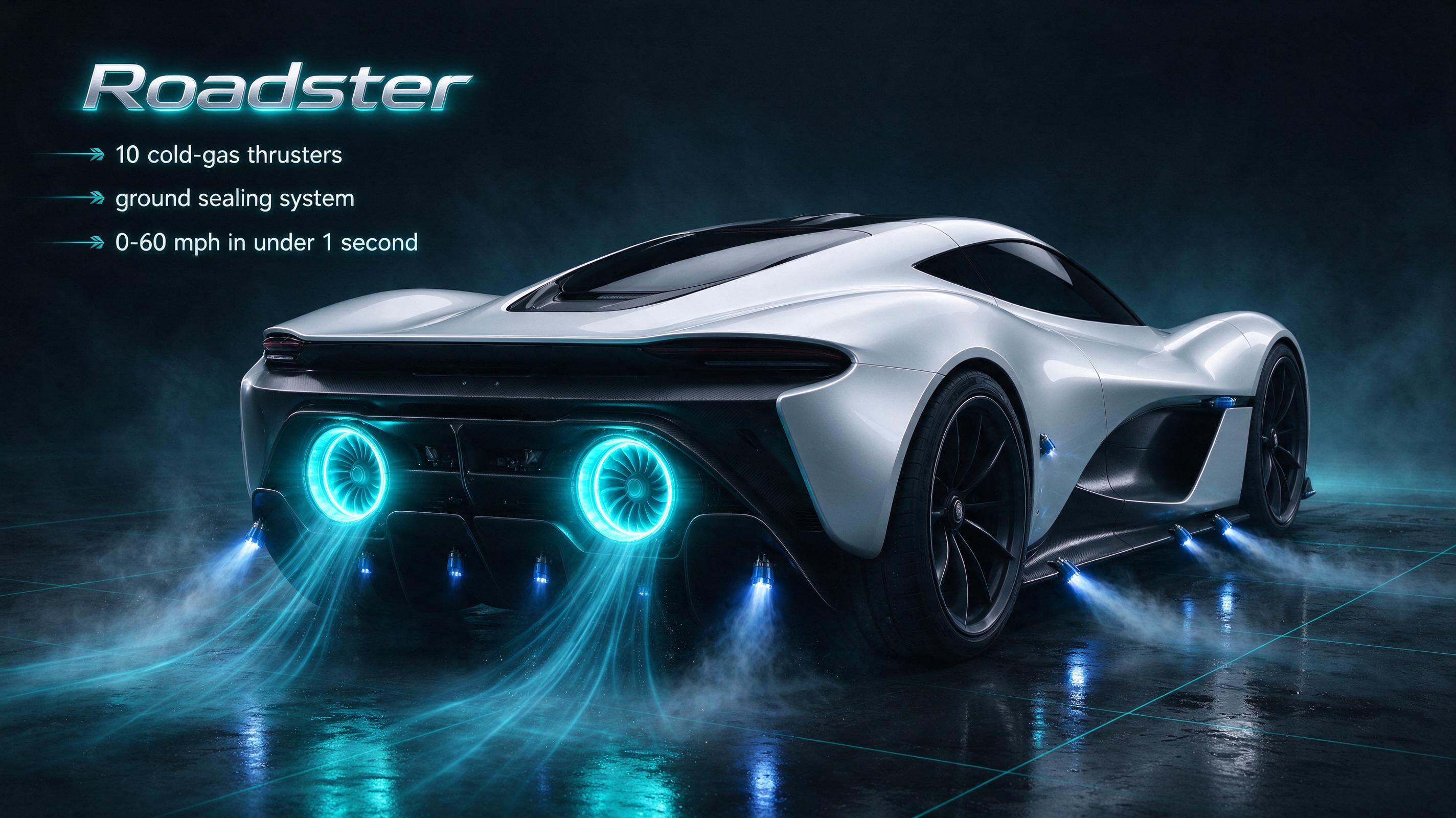
Three versions are listed on the product page, and Tesla labels them by where they are meant to operate. Performance, two seats, active aerodynamics and a multi-mode suction system, is road ready. Thrust, also two seats, adds rear-mounted thrusters that Tesla says take it from 0-60 mph in under 1 second, and is race ready. Rocket is a single-seater with thrusters around the perimeter that support forward and upward acceleration as well as lateral rotation, and is air ready. Musk first described this package in 2018 as roughly ten small thrusters arranged around the car.
Downforce at zero speed
The mechanism that matters most on this car has nothing to do with flight. Tesla describes a multi-mode fan and ground sealing system that acts as a downforce generator, pulling air out from beneath the vehicle, and claims the suction is strong enough to hold the car upside down while it is stationary. Powered fans and active wings work with a next-generation steer-by-wire system, and a Track Mode lowers the car and transforms the suspension so that high-downforce or low-drag modes can be selected for a circuit.
Wings need airspeed. Tyres need load and friction. A fan and a sealed floor produce load at zero speed, which is why the inverted-ramp segment of the launch demo is a downforce test rather than a stunt: without suction, no tyre holds a stationary car to a ceiling. The cost is energy, and an electric platform is the first one where buying downforce in watts rather than in drag is a straightforward trade, since the pack that feeds the motors can feed the fan. The lineage is not new. Brabham's BT46B fan car won a Formula 1 race in 1978 before the concept was banned, and the McMurtry Speirling used a fan to reach 60 mph in about 1.55 seconds. Neither was a product with a warranty, and Tesla has not published the fan's power draw, which is the number that decides how usable the trick is outside a demo.
Cold-gas thrusters as a control surface
The thruster package uses compressed gas rather than combustion: a tank, a nozzle, and all-electric actuators that Tesla says "offer precise thrust, completing micro adjustments within a fraction of a second" and stabilize the vehicle in flight. Engineering vice-president Lars Moravy put the hardware count at 10 cold-gas thrusters and a 600-litre compressed-air storage system. The tank heritage is aerospace: composite overwrapped pressure vessels of the kind used on Falcon 9, at a working pressure reported near 10,000 psi on the original design.
A cold-gas jet is a weak rocket, and thrust is the wrong place to look for the value. A car generates yaw in essentially one way today, by asking the tyres for it, and tyres are limited by friction and by how quickly load can be transferred. Ten thrusters around the perimeter give the body a second path to rotation, which is what lets the Rocket trim spin in place and hold an attitude mid-air, and what would show up on a track car as faster yaw response in a corner entry. I would read the package as a chassis-control system that happens to be able to fly, rather than a flying car that happens to have wheels.
The cost lands on the same ledger as the fan. A 600-litre air tank, a compressor to refill it and ten thrusters are mass and energy taken from the traction battery, and the range figures published this week are what that arithmetic produces. Tesla has not released the tank's mass, the gas supply, or the number of hops available before a refill, and the product page's own footnote says the specifications shown describe the Thrust augment only.
Specifications since 2017
Compare the launch page with the 2017 pitch, because the direction of travel is not uniform. In 2017 Tesla promised 0-60 mph in 1.9 seconds, a top speed above 250 mph, a 200 kWh battery, about 620 miles of range and a $200,000 starting price, with deliveries from 2020. What the company published this week is faster on acceleration and slower on almost everything else: under 1 second on the Thrust trim, roughly 300 miles (483 km) of range and a top speed above 230 mph (370 km/h) across all three versions, with no final price.
Range is the figure that moved furthest, from a claimed 1,000 km to 483 km. Some of that gap is a 2017 target meeting a validation process, and some is the physics of the previous two sections. On the numbers as published, an owner buying the fan, the compressor and the thrusters is buying them out of the same pack that has to deliver the range, and the product page carries the caveat that the specifications describe the Thrust augment as an optional upgrade.
The reservation terms are equally explicit. Reservations are refundable and are not purchase orders; Tesla states that the car is still in development and that it cannot guarantee delivery timing or delivery at all. Deposits run $50,000 for Performance and $250,000 for Thrust in the United States, and the Chinese site lists the Performance version only, at an intent deposit of 332,000 yuan, with a note that whether the car can be sold in a given region depends on the regulations in force there.
The A71 package and the delay list
The cold-gas package, called A71 internally, is the reason this reveal kept moving. A prototype was shown to Musk in late April and was not ready for a public demonstration, so the event slipped from 1 April to late April, then to August, then to October, when weather pushed it back a further two weeks. Musk's own description of the constraint was about validation rather than scheduling: there is enough technology in the car that it "requires a lot of testing and validation before we can actually have a demo and not have something go wrong with the demo."
The list of prior dates is long enough to be the actual specification of the program. Production was announced for 2020, then 2022, then 2023, then 2024, then early 2025. Last November the plan was a debut on 1 April 2026 and production 12 to 18 months later. Tesla's design chief Franz von Holzhausen told Jay Leno in August that the car was coming "very soon," two years after the last production date had already passed. An earlier version of the launch event was reportedly going to include the car driving upside down on a magnetized ramp before hovering, which Musk scrapped. Production is now planned for 2028, about eleven years after the prototype.
Halo car economics
Morningstar analyst Seth Goldstein argued in a September report that Tesla lacks a product that concentrates its best engineering in one car, and that the Roadster fills that role, with expected sales of about 2,000 units a year. Musk has framed it the same way. Analysts quoted before the event made the marketing argument explicitly: CFRA's Garrett Nelson expected the reveal to break Tesla's run of disappointing product announcements, and Dan Ives of Yorkville described the car as a high-end trophy case for the brand.
The financial mechanics are unusual for a company that has spent a decade arguing about manufacturing scale. The 2017 launch took $50,000 reservations and $250,000 for a Founders Series limited to 1,000 cars; the Thrust deposit today is the same $250,000, which is money lent to Tesla for a car with no announced price and no guaranteed delivery date. The market did not treat the reveal as a catalyst. Tesla closed at $362.44 on 15 October, down 1.29%, its fourth consecutive decline. The Roadster is also the first new Tesla passenger car with a steering wheel since the Model Y in 2019.
Industry implications
Downforce at zero speed is the first idea likely to spread. Grip that does not depend on airspeed or tyre load changes what is available to a stability system, and the cheapest place to reuse it is not a hypercar but the emergency manoeuvres of ordinary cars, where a few tenths of extra normal load at low speed would help and the sensors are already fitted. I would expect the concept to reach production vehicles as a stability feature before it reaches anything sold as a mode.
Thrusters raise a harder question for regulators than for engineers. A body force that changes yaw and lift independently of the tyres sits outside the assumptions behind stability control and braking standards, and a car whose behaviour depends on a compressed-gas system running out or failing is a new case in the rulebook. The product page's note that the Rocket trim is not available in all regions, and the Chinese site's warning about local regulations, both point at the same gate. The technology demonstration is finished; the approval work has not started.
The market signal is about the split between volume and engineering. Tesla is shipping a limited-run, invite-only, largely track-and-show vehicle on one side and robotaxis without steering wheels on the other, and Musk's own framing, that this is the last human-driven car the company will make and that driving will become a luxury, follows from that split rather than anticipating it. If the workforce and capital follow, the mass-market car becomes an appliance, and scarce engineering effort moves to low-volume products. That is the inverse of the 2006 plan, which sold a $109,000 Roadster to pay for the Model 3.
Two suppliers outside the car business stand to gain a reference design either way. Composite pressure vessels of the type used on Falcon 9 have not previously been a road-car component, and steer-by-wire at this level of feedback is still rare in production. Both are the kind of part that appears first in a halo car and later in a specification table.
The product page keeps its qualifiers close together. The thrusters are available with the Rocket trim only, which is not sold in all regions, the performance figures describe the Thrust augment as an optional upgrade, and the line under the three versions reads: not approved for public road use.
References
- Tesla Roadster product page
- Tesla reveals SpaceX-powered Roadster that flies and falls with style (TechCrunch)
- Tesla Roadster takes off; Chinese site opens reservations (National Business Daily)
- Tesla design chief says new Roadster coming 'very soon' (Electrek)
- Do you believe it can fly? Tesla Roadster to make debut (Axios)
- Tesla Roadster, second generation (Wikipedia)
Loading comments…